
For many runners, the pursuit of a “perfect” shoe feels like a compromise. If you have wide feet and high arches, you are likely familiar with the “fit gap”: shoes that are wide enough often lack the structural integrity for your arches, while shoes with the right arch support frequently pinch your metatarsals.
Finding the right footwear when you have these specific anatomical traits isn’t just about comfort; it is about injury prevention. High arches and wide feet create a unique biomechanical profile that requires a thoughtful, strategic approach to shopping. Here is your guide to navigating the market to find a shoe that truly fits.
Understanding Your Anatomy: Why the “Double Challenge” Matters
To choose the right shoe, you must first understand how your feet interact with the ground.
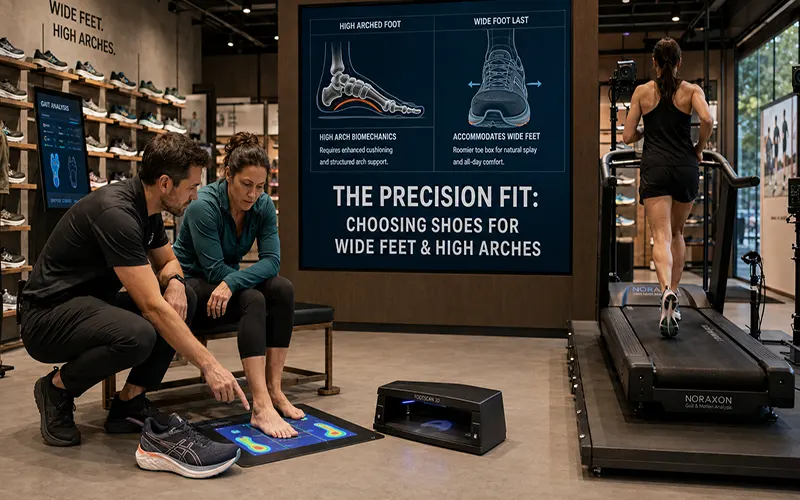
- The High-Arch Biomechanics (Supination): High arches are typically rigid. Unlike a flat foot, which collapses (pronates) to absorb impact, a high-arched foot acts like a stiff lever. Because it doesn’t naturally absorb shock, the impact of every stride is sent upward into your ankles, shins, and knees. This is why high-arched runners often suffer from “shock-related” injuries.
- The Wide-Foot Reality: A wide foot isn’t just about the length/width ratio; it’s about volume. If your shoe is too narrow, you increase the risk of metatarsal stress, bunions, and “hot spots.” For a wide-footed runner, a generous toe box is non-negotiable.
The “Gold Standard” Checklist for Your Search
When scanning product descriptions—or better yet, trying on shoes—look for these specific design markers:
- Width Labeling: Do not settle for “standard” widths. Look for brands that offer dedicated 2E (wide) or 4E (extra wide) options. Many high-end performance shoes come in these widths, but you must specifically seek them out.
- Removable Insoles: High arches often require custom or over-the-counter orthotics to provide better arch contact. Ensure the shoe has a factory insole that can be easily removed to make room for your own inserts.
- Wide-Base Outsole: Look for shoes that feature a broad base of support under the midfoot. This provides stability for a high arch that might otherwise feel like it’s “rolling” off the edge of a narrow platform.
The Cushioning Dilemma: Finding the Balance
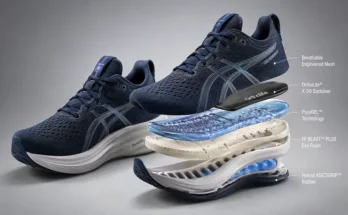
Because your high arches lack natural shock absorption, you generally need a high-stack, plush cushioning system.
However, there is a catch: high-stack shoes can sometimes feel unstable. When shopping for wide feet, ensure that the base of the shoe is wide, not just the upper. If the upper is wide but the midsole is narrow, your foot will overhang the edges, which creates instability and can lead to ankle rolls. Look for terms like “stable cushioning” or “plush neutral,” which indicate a shoe designed to provide impact protection without forcing your foot into a specific, restrictive shape.
The Fitting Strategy: Testing and Lacing
Even the best shoe can feel poor if the lacing is wrong. Follow these steps to maximize your fit:
1. The Width Test
When you stand in the shoe, your forefoot should feel supported but not compressed. If you can see your foot bulging over the edge of the midsole, the shoe is too narrow. You should be able to wiggle your toes freely; if you feel them touching the side of the shoe, look for a wider size.
2. The Lacing Trick: Window Lacing
Runners with high arches often experience “top-of-foot” pain because the shoe’s tongue presses down on the arch. To fix this:
- Window Lacing: Skip the eyelets that sit directly over the peak of your arch. Thread the laces straight up the sides of the shoe instead of crossing them over the arch. This “window” relieves pressure while still keeping the rest of the shoe snug.
Pro-Tip: Mind Your Socks
If you have wide feet, your sock choice is just as critical as your shoe choice. Avoid thick, heavy cotton socks which take up valuable volume. Opt for thin, synthetic performance socks that offer a snug fit without adding bulk.
When to See a Professional
If you have tried multiple wide-fit shoes and still experience numbness, sharp pain, or recurring injuries, it is time to move beyond the “off-the-shelf” solution.
Consult a podiatrist or a physical therapist specializing in running. They can assess whether you require custom orthotics. Often, the issue isn’t the shoe itself, but the lack of contact between your high arch and the shoe’s footbed. A custom insert can bridge that gap, distributing pressure more evenly across your entire foot and making your favorite wide-fit shoes feel significantly more comfortable.
Finding the right shoe for wide feet and high arches is a process of trial and error, but it is one of the best investments you can make in your running longevity. Do not be swayed by trends or aesthetic popularity; prioritize the mechanics of your own feet. The “perfect” running shoe is the one that disappears—a shoe that provides the cushioning your arches need and the room your feet crave, leaving you free to focus on the run itself.