

For the marathoner, the training block is a war of attrition. You are asking your body to absorb thousands of repetitive impacts over hundreds of miles. As the training cycle intensifies and the long runs stretch into the 15-to-20-mile range, your greatest enemy isn’t just distance—it is fatigue.
As your muscles grow tired, your running form naturally begins to break down. For runners with flat feet or overpronation, this fatigue-induced form collapse can lead to significant pain or injury. This is where the “max-cushion stability” hybrid category shines. It provides the protective layering needed to shield your joints from impact while offering the structural scaffolding necessary to keep your gait cycle aligned, even when you are exhausted in the final miles of a long run.
The Fatigue Factor: Why Max-Cushion Stability Matters
In the early stages of a run, your muscles act as natural shock absorbers. However, by mile 14, those muscles are spent. Your arches begin to drop, your ankles roll inward, and your cadence may slow.
A max-cushion stability shoe acts as your “form insurance.” The high-stack foam (the cushion) absorbs the mechanical energy that your tired muscles can no longer dissipate, while the stability features (the frame) act as a gentle intervention to keep your foot from rolling into an injury-prone position. It is the perfect marriage of comfort and control for high-mileage training.
The Biomechanics: Cushion vs. Stability
There is a common misconception that “max cushion” means “soft and unstable.” Today’s top-tier marathon trainers have debunked this.
- Responsive vs. Mushy Cushioning: You want foam that is responsive—it should compress to absorb impact but “spring back” to provide energy return. Avoid shoes that feel like walking on memory foam; they absorb energy but don’t give it back, which will make your legs feel like lead by mile 18.
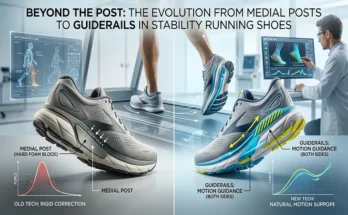
- The Stability Frame: Modern stability is no longer just a hard piece of plastic in the arch. Look for systems like “GuideRails” or H-Frames, which provide support on both the medial and lateral sides of the shoe. These systems only engage when you need them—when your form starts to wobble—making them far more comfortable than traditional corrective devices.
The Training Cycle Strategy: How to Use These Shoes
You do not need to wear your max-cushion stability trainers for every single workout. In fact, a balanced training rotation is key to long-term health:
- The Long Run & Recovery: This is where your max-cushion stability shoes belong. Use them for your weekend “long” efforts and your “recovery” runs when your legs are already sore from the previous day’s intensity.
- Speed Work: For track intervals or tempo runs, you may prefer a lighter, more agile shoe. If you have severe stability needs, look for a “light stability” model for speed days to keep your mechanics safe without the weight of a max-cushion trainer.
- The Taper: During your final two weeks of marathon training, continue to use your max-cushion trainers for your easy runs. They will keep your legs feeling fresh and protected until race day.
Fit & Feel: Accounting for the “Swelling Factor”
One of the most overlooked aspects of marathon preparation is foot swelling. After two or three hours on your feet, your feet can expand by a half-size or more.
- The Thumb-Width Rule: Ensure you have a full thumb’s width of space between your longest toe and the front of the shoe. If your toes touch the end while standing in the store, they will definitely be black-and-blue by mile 20.
- Width Considerations: If you are prone to bunions or “hot spots” on the sides of your feet, consider a 2E or 4E wide model. A shoe that is slightly wider provides the necessary room for your feet to expand without being constricted by the upper material.
Coach’s Pro-Tip: The Mid-Run Sock Strategy
If you are prone to blistering during ultra-long runs, try the “mid-run sock swap.” Carrying a spare pair of dry, synthetic, moisture-wicking socks in your fuel belt and changing them at the halfway point of a 20-miler can be a game-changer. Keeping your skin dry is just as important as the cushioning under your feet.
Testing for the Marathon
Before you commit to a shoe for your goal marathon or training block, “stress test” it:
- The 10-Mile Test: Don’t wear a brand-new shoe for a 20-miler. Take them for a 10-mile run first to identify any friction points.
- The “Lace-Lock” Adjustment: If you feel your heel slipping, use the top eyelet (the “runner’s loop”) to secure your ankle. This prevents your foot from sliding forward, which is a common cause of toe-banging in long runs.
Prevention is Performance
Success in marathon training is not just about how fast you run; it is about how many consistent weeks of training you can stack together. Injury prevention is the ultimate performance enhancer. By choosing a max-cushion stability shoe, you are investing in your ability to recover faster, train harder, and arrive at the starting line feeling fresh, supported, and ready to go the distance.