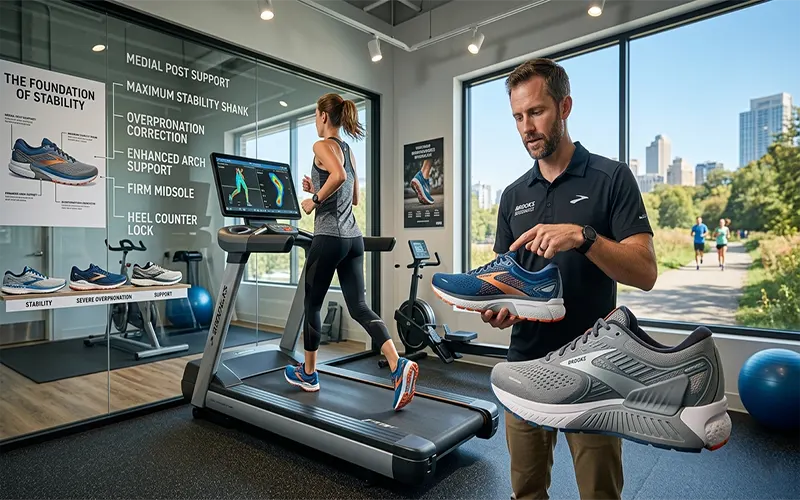
For runners with flat arches and severe overpronation, the running shoe is more than just a piece of equipment—it is the structural scaffolding for their entire kinetic chain. When your arches “pancake” upon impact and your feet roll excessively inward (overpronation), it creates a chain reaction of misalignment that travels from your ankles up to your knees, hips, and lower back.
Finding the right shoe is not about “limiting” your foot; it is about providing a foundation that allows you to move efficiently and pain-free. Here is how to identify the stability features you need and which models are currently leading the category.
The Biomechanics of Stability
When you have severe overpronation, a neutral running shoe—which is designed to flex and move naturally—will likely collapse under your weight. To counteract this, you need a shoe engineered to control that inward roll.
Key Stability Mechanisms
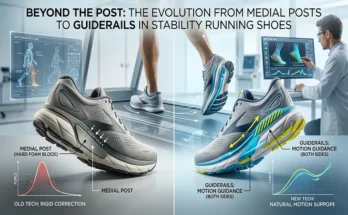
- Integrated Guide Rails: Unlike old-school stability shoes that used rigid plastic “medial posts,” modern stability technology uses integrated “bumpers.” These act like guardrails on a highway; they are unobtrusive until you start to drift, gently nudging your foot back into alignment.
- Dual-Density Midsoles: Many stability shoes feature a firmer, higher-density foam on the medial (inner) side of the midsole. This firmer foam resists the compression that causes your arch to collapse, providing a more consistent landing platform.
- Wide-Base Platform: A broader footprint at the heel and forefoot is essential. A wide base creates a more stable landing surface, reducing the “wobble” that occurs when an overpronating foot strikes the ground.
- Rigid Heel Counters: A stiff heel cup cradles the heel bone (calcaneus), preventing it from sliding or tilting excessively, which is the first step in controlling the rest of the gait cycle.
Stability Checklist: What to Look For
When you are in the store or browsing online, prioritize these specific design markers:
- The “Twist” Test: Hold the shoe by the heel and toe. A severe stability shoe should have significant torsional rigidity—it shouldn’t twist easily like a dishcloth.
- The Platform: Look for a shoe that sits “flat” on the ground. A wide, flared outsole is a primary indicator of a stable foundation.
- Arch Contour: Flat-footed runners often find “high-arch” inserts uncomfortable. Look for a shoe that offers supportive rather than intrusive arch structure—you want to feel cradled, not poked.
- Width Options: Because flat feet tend to splay and widen upon impact, look for models that offer wide (2E/4E) sizing options.
2026 Top Picks for Severe Overpronation
| Shoe Model | Primary Stability Strategy | Best For |
| Brooks Adrenaline GTS 25 | Integrated GuideRails | All-around daily training |
| ASICS GEL-Kayano 32 | Responsive arch pod & flared base | Plush, long-distance comfort |
| Saucony Hurricane 25 | CenterPath technology | High shock absorption |
| HOKA Arahi 8 | H-Frame support | Lightweight stability |
| New Balance 860 v14 | Dual-density foam | Consistent, “locked-in” feel |
The Myth of “The Harder, The Better”
There is an outdated belief that stability shoes must feel like “bricks” to work. This is no longer true. Modern engineering has allowed brands to combine plush cushioning with strategic support. You no longer have to sacrifice the “bouncy” feel of a modern running shoe to get the structural control your feet require. Shoes like the Brooks Adrenaline GTS or ASICS GEL-Kayano provide a high level of cushioning that absorbs impact while simultaneously using geometry—rather than rigid plastic—to keep your gait cycle neutral.
Crucial Fitting Tips
Even the best stability shoe will fail if the fit is incorrect:
- The Midfoot Check: Ensure the midfoot feels snug but not constricted. Since you have flat feet, you may experience “rubbing” in the arch area if the shoe is too narrow.
- Thumb-Width Rule: Always ensure there is a thumb’s width of space between your longest toe and the front of the shoe. If the shoe is too short, your arch support will sit in the wrong place, causing irritation rather than support.
- Sock Volume: If you use custom orthotics, remember that they take up more volume than the factory insole. You may need a thinner performance sock to prevent the shoe from feeling too tight over the instep.
When to See a Specialist
If you are wearing high-quality stability shoes and still experiencing sharp pain (especially in the arch or shin), it is time to consult a professional. Severe overpronation can sometimes lead to structural issues that over-the-counter shoes cannot address. A podiatrist or physical therapist can perform a professional gait analysis and determine if you need custom orthotics to replace the factory insoles. Remember, a shoe is a tool; orthotics are often the “tuner” that makes the tool work specifically for your unique anatomy.
Stability is the base upon which all your running performance is built. By selecting a shoe that respects your anatomy—rather than trying to force it into a neutral pattern—you are effectively removing the biggest roadblock to your success. Whether you are training for your first 5K or your tenth marathon, the right stability shoe will allow you to focus on the rhythm of your run, confident that your feet are supported every step of the way.