In the era of the “super shoe,” the running world has been transformed by a technological revolution that promises—and delivers—faster times and improved efficiency. But as these high-tech tools become more accessible, many runners are left wondering: do I need a carbon-plated shoe for every run, or should I stick to my trusty workhorses?
Understanding the biomechanical and functional differences between carbon-plated racers and daily trainers is essential for maintaining both your performance and your long-term health.
The Technology Breakdown: What Makes a “Super Shoe”?
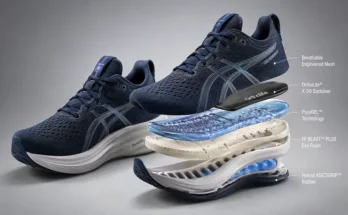
The performance leap seen in modern racing shoes, such as the Nike Vaporfly or Adidas Adios Pro series, is the result of a “synergistic effect” between three core components:
- Carbon-Fiber Plates: Unlike traditional, flexible midsoles, carbon plates are stiff and often curved (rockered). They act as a mechanical lever, reducing the work required by the foot and ankle joints during the “toe-off” phase of your stride, which improves your overall running economy.
- PEBA-Based “Super Foams”: These lightweight, highly resilient materials (polyether block amide) offer significantly higher energy return than the standard EVA (ethylene-vinyl acetate) foam found in most daily trainers. They compress easily under load and spring back instantly, providing a propulsive sensation.
- Aggressive Geometry: Most racers feature a high stack height and a pronounced rocker shape. This design promotes a smooth, efficient roll from heel to toe, encouraging a faster cadence and shorter ground contact time.
Daily Trainers: The Foundation of Your Training
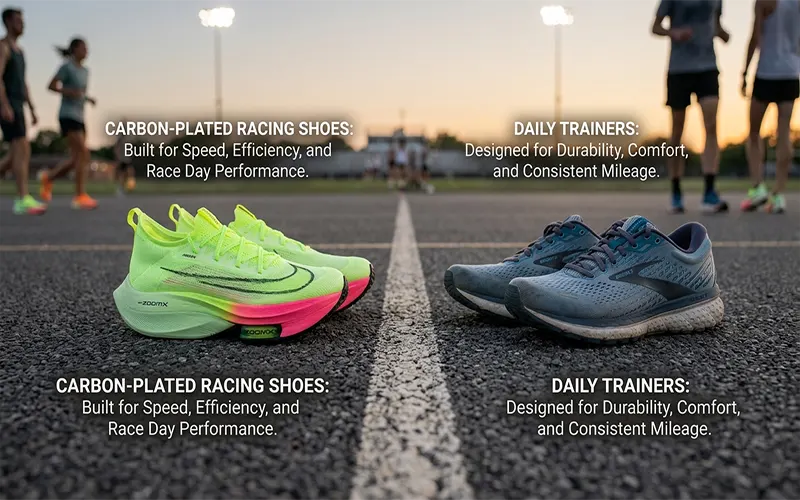
If the carbon-plated racer is a sports car meant for the track, the daily trainer is your reliable, rugged SUV.
Daily trainers are engineered for durability and consistency. They typically use more robust outsole rubber and denser, more stable foam. Their primary role is to provide a consistent platform that allows your muscles, tendons, and bones to adapt to the stresses of running through natural loading. Because they are more flexible and provide more ground feel, they encourage your feet and ankles to engage and stabilize themselves, building the intrinsic strength necessary to stay injury-free.
Performance vs. Preservation: The Trade-off
While carbon-plated shoes offer a clear metabolic advantage—studies suggest a 2% to 3% improvement in running economy—they come with significant trade-offs:
| Feature | Carbon-Plated Racing Shoes | Daily Trainers |
| Primary Goal | Performance & Speed | Longevity & Adaptation |
| Stiffness | High (Rigid plate) | Moderate to Low (Flexible) |
| Stability | Lower (Unstable stack height) | Higher (Stable platform) |
| Durability | Lower (300–500 km) | Higher (500–800+ km) |
| Best Use | Races, Tempo, Intervals | Easy runs, Long, Recovery |
The “Crutch” Effect and Injury Risk
The very technology that makes “super shoes” fast can be detrimental when used exclusively. By offloading much of the work at the ankle and foot, these shoes may weaken the very structures you need for a healthy stride. Furthermore, their aggressive, stiff, and often unstable design can magnify biomechanical imbalances, potentially leading to overuse injuries like Achilles tendinitis or metatarsal stress fractures if your body isn’t conditioned to handle them.
The Decision Matrix: How to Rotate Your Shoes
A diverse shoe rotation is the hallmark of a smart runner. Here is a recommended strategy to balance speed and safety:
- The “Fresh” Racer: Save your newest, low-mileage carbon shoes specifically for race day or high-intensity “key” workouts (e.g., track intervals or tempo sessions) where you need to hit race-pace targets.
- The Daily Workhorse: Complete 70–80% of your total weekly mileage in supportive, flexible daily trainers. This is where your base fitness is built, and where your feet stay strong.
- The Transition: If you are preparing for a marathon, it is wise to do a few long runs in your plated shoes to let your lower legs adapt to the unique loading profile, but do not make them your only shoe.
Carbon-plated shoes are a remarkable scientific achievement, offering a tangible boost in running economy. However, they are a specialized tool, not a universal replacement for foundational training. True running longevity comes from a balanced approach: using “super shoes” to push your performance limits during intensity, while relying on durable daily trainers to build the structural integrity required to support that speed.
By strategically rotating your footwear, you ensure that you aren’t just faster on race day—you’re healthy enough to keep showing up to the start line for years to come.