
For decades, the running shoe industry spoke one primary language when it came to stability: “Correct the pronation.” If a runner’s foot rolled inward excessively, the solution was straightforward—place a physical barrier in their way. Today, however, the industry has shifted toward a more sophisticated dialogue: “Guide the motion.”
The transition from traditional medial posts to modern systems like GuideRails or stabilizing frames represents a fundamental shift in how we think about the kinetic chain. For runners who have spent years in rigid, corrective footwear, understanding this evolution is key to finding a shoe that feels less like a medical device and more like a high-performance tool.
The Traditional Approach: The Medial Post
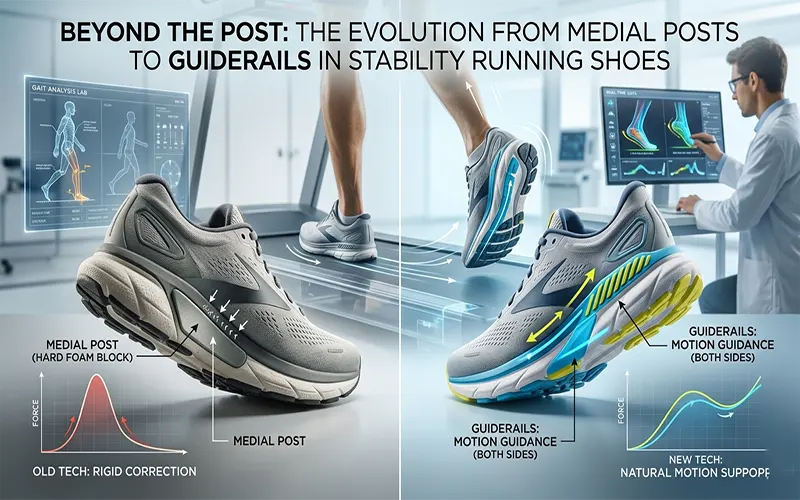
For much of the last forty years, the medial post was the gold standard of stability. It is easy to identify: if you look at the arch side of a traditional stability shoe, you will often see a section of the midsole that is a different color or feels significantly firmer to the touch.
How It Works
A medial post is a wedge of higher-density material—usually firmer EVA foam or, in older models, rigid plastic—inserted into the arch side of the midsole. Its function is mechanical: when your foot begins to collapse inward (overpronate), it hits this firmer material, which resists the compression and physically pushes the foot back toward a neutral position.
- The Pros: It is a proven, reliable mechanical block. If your pronation is severe and structural, the “brick” of a medial post provides unwavering resistance.
- The Cons: By physically blocking the movement, it can feel “intrusive” or “harsh” under the arch. For runners who only need mild support, a medial post can feel like walking on a golf ball, sometimes leading to arch irritation or a feeling that the shoe is forcing your foot into an unnatural shape.
The Holistic Approach: GuideRails and Frames
In recent years, brands like Brooks (with their trademarked GuideRails) and others (using H-Frames or holistic stabilizing geometries) have moved away from “correcting” the foot and toward “guiding” the entire lower limb.
How It Works
Instead of a single, firm block on the inner arch, these systems act as “bumpers.” They typically consist of firmer foam structures on both the medial (inside) and lateral (outside) sides of the heel and midfoot.
- The Philosophy: Rather than just stopping the arch from collapsing, these systems focus on the kinetic chain. The idea is that excess rotation at the ankle often travels up to the knee and hip. By using “bumpers” to contain the heel and midfoot in a safe range of motion, the shoe allows your natural gait to continue while gently limiting movement only when you deviate from your baseline.
- The Feel: Because the support is spread across a wider area and doesn’t rely on a single hard block, the transition feels significantly smoother. You aren’t being “corrected”; you are being “channeled.”
Biomechanical Comparison: Medial Post vs. GuideRails
| Feature | Medial Post | GuideRails / Frames |
| Mechanism | Firmer wedge (barrier) | Dual-side bumpers (channeling) |
| Target Area | The longitudinal arch | The entire heel and ankle complex |
| Support Feel | Corrective (Firm, noticeable) | Holistic (Supportive, integrated) |
| Best For | Severe, structural overpronation | Mild to moderate pronation/knee rotation |
| Analogy | A pothole filler | Highway guardrails |
Which System Is Right for You?
The best way to choose is to listen to what your body has been telling you during your runs.
- Stick to Medial Posts if: You have a history of severe, structural overpronation, or if you have found in the past that “lighter” stability shoes simply do not provide enough resistance. If your arches collapse significantly and you need a rigid, “no-nonsense” correction to stay pain-free, the traditional post remains a gold-standard solution.
- Try GuideRails (or modern Frames) if: You find traditional posts uncomfortable, intrusive, or “clunky.” If your primary issue isn’t just your arch, but rather knee or hip pain that seems to flare up as you get tired, these holistic systems are designed to keep your joints aligned without the “correction” feeling. They are the ideal choice for the runner who wants support that disappears once you find your rhythm.
The evolution from the medial post to the GuideRail system is, at its heart, an evolution toward comfort. By moving away from rigid barriers and toward holistic guidance, footwear brands have made stability accessible to a much broader range of runners.
Ultimately, both technologies serve a singular purpose: to allow you to run more miles with less risk of injury. Whether you rely on the proven, mechanical resistance of a post or the sophisticated, integrated guidance of a rail, the “best” shoe is the one that aligns with your specific biomechanical needs and, most importantly, feels like an extension of your own stride.